You Never Stop Learning, Not Even About Yourself

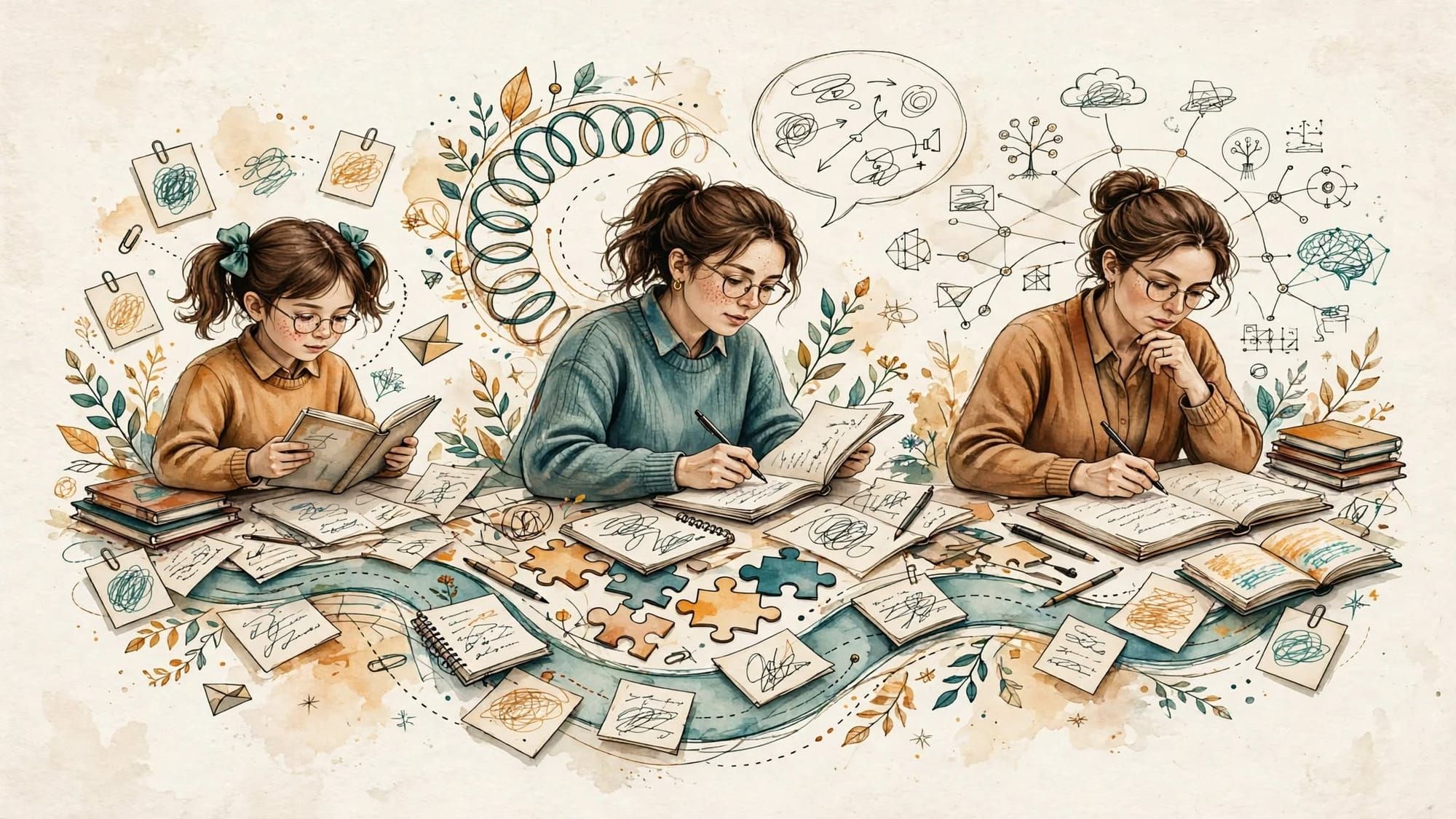
As the saying goes, you never stop learning in life. Learning is an ongoing process that accompanies us throughout our lives. It broadens our horizons, refines our skills, and adds something new to our existing store of knowledge. But how does this learning process develop from our early years as students, through university or vocational training, to middle age? Learning during our school years, at university, or in training is somewhat more obligatory than it is in middle age. Apart from some mandatory professional training, we largely decide for ourselves how to continue our education in middle age. But as suggested at the beginning, human beings are curious individuals who need new information in order to feel fulfilled and therefore have the drive to keep advancing mentally. When we look at this whole development, from our youth to later adulthood, we also wonder which learning methods we use, or at least adapt and transform, over time. What I mean is that we learn and absorb information differently as schoolchildren than during our student years and in our later, more advanced years. I noticed this myself when I decided to study Vedic astrology. During that time, I realized that to take in all this knowledge, I had to copy everything word for word. This was completely new to me; I had never learned in this way before.
This led me to look more closely at different learning techniques and modalities.
One of the five learning techniques I will discuss is active recall. This is when you test yourself and retrieve the information directly from your brain, instead of just mechanically repeating texts, for example, by rereading or highlighting.
Then there is spaced learning. It works as follows: the material is reviewed at increasingly longer intervals, for example after one day, three days, and one week, to counteract forgetting.
Next is the Feynman technique, a learning concept in which the learner explains the material in simple words, as if teaching it to a layperson. The advantage of this approach is that it uncovers gaps in knowledge and understanding.
Interleaved learning is also interesting. Here, different topics or tasks are mixed together within a single study session. This helps avoid focusing too narrowly on one topic, and it keeps the learning process varied.
Finally, there is dual coding and mind mapping. Spoken or written information is linked with visual representations such as diagrams, graphics, or mind maps.
This brings us to the sensory learning modalities, also known as the VARK model.
V for Visual: This suits learners who find it easier to retain knowledge through diagrams, graphics, charts, and color-coded notes.
A for Auditory: Auditory learners prefer spoken lectures, group discussions, and voice notes.
R for Reading/Writing: In reading and writing, the student concentrates on text-based content and summaries and produces lists and other written work.
K for Kinesthetic: With this modality, learning is hands-on, through physical models, experiments, and direct application.
Keep in mind these are preferences, not fixed types.
When I look back on my learning journey and how it has developed over my life, I can say one thing: I was never a visual, auditory, or kinesthetic learner. In my case, reading and writing became the modality that has strongly shaped my learning process for years and continues to do so. What I mean is that as a young schoolgirl, I mainly read texts and information and kept rereading them until they stuck in my memory. I then combined this with spaced learning. That is, I kept reviewing the material at intervals of days until the teacher tested that knowledge through exams.
Looking back on my time at university, however, I have to say my learning behavior changed somewhat. Simply reading the material was no longer enough; I had to take notes to process the knowledge more quickly and concisely. It was no longer just about getting good exam grades, but also about writing term papers and giving presentations. In this new learning process, I added the Feynman technique, which is excellent for preparing presentations and learning content. You have to consider what you know, whether it is enough, and what your fellow student or listener knows. You also need to convey this knowledge in simple language so the listener can process the information more easily.
And when I look at myself now, in my current learning process, I notice that reading texts still takes priority, but the texts have to be highlighted, and the notes have to get longer; that is, I have to transcribe longer passages in writing so that I can keep working with the information.
By and large, nothing has changed for me; I am clearly and unmistakably the classic reading and writing type. It has only deepened and become more refined. Taking notes on longer passages of text is demanding not only because the material is hard to process, but also because I now go into more detail about the knowledge itself.
One thing is certainly clear: you never stop learning in life, not even about yourself and how you learn.
©2026, Vasiliki Papadopoulou